Pages

February 22, 2016

What we have learned

One of the things we have learned by following the case from the earliest stage, is the importance of the hearings. This is the time to ensure that trees and nature is prioritized. That the existing trees are incorporated in the design, to the fullest extent. The difference between the previous and today's winner of the competition for Sølund retirement home is like night and day.


The Sølund files are now available online (a whopper of a pdf file, in Danish), where every step of the process is laid out. The restrictions, the evaluation, the individual cases and best of all the winning project from C.F. Møller and Tredje Natur. Trees are mentioned throughout the material, all the way to instructions to care for them during the construction phase. So reassuring.


A few nice screen dumps from the material (instructions to care for and incorporate the trees).


The winner has kept the existing parking ramp for the underground facility. This means that the surrounding soil is untouched, and the existing nature can be preserved. Well done! Note the winning team's proposal: the Ladytree is properly named (Dametræet).


Makes your heart swell.

More Sølund post, with the most recent first:
Yaaaaaaaaaaaaaay, Feb. 17 2016
The unveiling, Feb. 16 2016
Save the Ladytree, March 20 2013
Sølund, Feb. 26 2013

February 17, 2016

Yaaaaaaaaaaaaaay

The winning team of the new Sølund retirement home have been announced: C.F. Møller and Tredje Natur (translates into: Third Nature, which sounds promising). It looks like the old beech on the corner survives, but it is impossible to tell from the renditions if the Ladytree will too. (to be updated)

Update:
Yaaaaaaaaaaaaaaaay, I have just talked to one of the architects, in his owns words "of course we have incorporated the Ladytree". Along with other old trees. For now we will let them celebrate, and then we will make a full tree count at another time. Oh, this is such good news!

PS! I have spoken to the new owners of the premises KAB, and they are touched by the present by arborists Morten & Rødderne, and the removal of the evil ivy. I have hooked them up and when the big day arrives, it will be properly documented of course.

February 16, 2016

The unveiling

Tomorrow at 2PM the fate of more than 70 trees on the Nørrebro retirement home Sølund, will be revealed. Among them the Ladytree, our beautiful 154 year old ginkgo biloba and the contemporary majestic beech on the corner. Starring in our avatar, as the endangered pair.


The first winner of the new Sølund retirement home competition, was a sad, dense and naked colossus. Fortunately, that plan was shut down. A majority in city hall wanted more parking spots, and they were granted that, if the competition was allowed to start over. Tomorrow we will know the outcome.

In the hearing material for the competition the number of trees on the ground, were halved on the map (!), and the Ladytree marked as not worth preserving (!). It turns out that the project manager had revoked the status, to leave more available space for underground parking. With massive objections from the neighbors and other persistent parties, we managed to get the tree marked as worth preserving. Meaning only that the architects are encouraged to keep it around, but not obligated. 

Nerve wracking!

Sølund have been city run and owned until recently, and the Ladytree have been left to suffocate in the ivy for decades. It is a painstaking and costly affair to remove 40+ years of ivy from a six story tall tree, but amazingly we have been contacted by the certified arborists Morten & Rødderne (Morten and the roots), offering to liberate the Ladytree as a present for the citizens and Save the Urban Trees. 

What a classy move! Now all we need is for the project winner to spare our tree. First it must be saved, and then freed. Fingers crossed, everyone..

Watch the Ladytree on P1 Natursyn's small video 

The urban oasis about to be destroyed, Feast your eyes on Classic Copenhagen.

February 11, 2016

Happy birthday!

Three years ago on this day, Red Byens Træer (Save the Urban Trees) was born with a single question on Facebook: “Time to save some trees, anyone with us?”.

As it happens, there were. Save the Urban Trees is the citizen’s voice and a place to communicate with each other, the city and all the engaged tree experts. Today, I attended a meeting on the University of Copenhagen to prepare for a presentation in April. The tree-tribe of Denmark meets up at a theme day for old trees, and I will be introducing our movement. Imagine that?

We are going to save so many trees, we have only just begun.

Happy birthday all! : )


The first question: Time to save some trees, anyone with us? It still goes..

January 31, 2016

NIghtmare on Møllegade

On the corner of Møllegade and Guldbergsgade on Nørrebro, the city is preparing to fell fifteen out of eighteen big and healthy trees, for a tile square.

For two years we have fought to be heard, and make them incorporate as many trees as possible in the new design. We have exposed the department's lies to the following group and citizens wanting a green square, stating the trees were in poor condition and not worth preserving. Only when the plan was set, did they admit that the trees were healthy and it turns out many even marked as worth preserving.

At the audience for the Committee in charge of Technical- and Environmental Affairs, we handed over 2800 signatures, from citizens who want to preserve the trees on the square. The square is part of a larger plan for the area, of which a few other plans have been cancelled along the way: the petting zoo By Oasen survived, and the bike lane going straight through the City of The Elderly, was dropped. A plan no one wanted or needed.

The same can be said about a naked tile square. The project is in two parts: the kindergarten gets a new playground on the other side, and the recycling station will no longer be locked off. For a long time we believed that there would be a bike lane through the square, but it is a pedestrian affair only.


This big ash tree will be felled to make space for a toy shed for the kindergarten. Why can't they place that shed up against the new wall, facing the square? You don't cut down a big tree to place a shed for toys. You just don't!

At our audience we introduced a suggestion from the building specialists, recommending the use of screw foundations for the (other) shed. This would spare three big ash trees on the opposite side, along Møllegade. The Department admitted this was a viable option, sparing the roots of the trees, but we still don't know if they will take advantage of it. The citizens have not been granted even one more tree.

The democratic process in this case has been a disgrace. Our complaint was handled by the very people we complained about. They denied having lied to the following group and citizens, as proven by the health report that they provided much later. Sneaky.

Following this horrible process I have talked to everyone from the Ombudsman to The Environmental Board of Appeal and the Local Government Denmark, trying to find a way to try our case. We have nowhere to turn. And now they are preparing to fell our fifteen beautiful trees. This is a nightmare.


Our beautiful endangered trees. Half of the wall is preserved, the corner will be removed. 
Some facts, black on white (In Danish, let me know if you need translating):


May 2015: Project manager discourages the committee from sparing the three ash trees facing Møllegade, as the nearby digging for the shed, is expected to damage over 40% of the roots, and thereby creating a risk tree. But as we know, and the department later admitted to (below), a screw foundation is the obvious solution, limiting damage to the roots to a minimum.


October 2015: the department's answer to the suggested method of screw foundation. Here, it is obvious that the solution opens up for possible preservation of the three trees behind the shed, which is moved slightly from the wall.


Anyone left to help us out here?


Previous posts, two years of fighting for the Møllegade trees:

Read this and the posts above in Danish, on the mother blog here: Red Byens Træer


January 25, 2016

A dropped ball (hearing reply)

We made the deadline for the hearing reply, for the Natural History Museum, with the prospect of total deforestation of the entrance area. After the last post, so many citizens have left impressive hearing replies. And hallelujah for that because all the trees got from the Local Council of Central Copenhagen, was one sentence: "Include the existing trees in the project." Gee.

The trees are the ball that everyone thinks someone else got, and again it ends up dropped. If we had not left our replies, the trees would have been invisible in the process. That is a scary thought? Knowing how much the citizens prioritize the urban nature? We need a loud and clear voice, speaking for the trees, and we can no longer afford to trust anyone else with the ball.

Hooray for citizens who look after the urban trees! <3

Our hearing reply:

Hearing reply for the National History Museum.

This reply concerns the entrance area for the new Natural History Museum, where the layout is still so unfinished that apparently anything can happen. However, yet another rendition without trees, sounds off the alarm.

Copenhagen have so few old trees left, and too few street trees in general. They are constantly felled to make room for this or that project. Always with the promise of "replacement". But there is no replacing these old trees.

Why the trees in the entrance area should be preserved:
The trees help us in so many ways. They absorb water (bigger = more), and takes the pressure of the infrastructure and basements at flooding. They clean our air, store CO2 and absorb a part of the lethal particles, killing off 500 Copenhageners annually. They absorb the noise from the traffic, have a speed reducing effect on drivers and increase safety for pedestrians and cyclists. Big trees also help reduce urban heating. 

Biodiversity in Copenhagen suffers, and the every felling and removal of nature cuts into the green corridors. This affects the odds of survival for urban wild life. The idea of replacement only works on paper: a 100 year old organism can't be recreated in our lifetime.

The WW2 shelters (bunkers):
Most of the old trees by the entrance at Natural History Museum is entangled in the foundation of the bunkers, meaning the bunkers should be incorporated into the new design if at all possible. By removing the bunkers, a large part of the small urban forest will go too. 

The worker's village:
A part of the entrance area is expected to be used as a worker's village for the workers. Usually this entails flattening of the entire area, and felling of all trees. But we have seen new ways of creating these places, without removing the trees. The minimal annoyance the trees would give, is compensated by 50+ of daily appreciation for all. Wrap the trunks and give the trees a chance to survive, where ever possible. This instruction should be included in the final approval.

The glass structure:
The big glass structure poses a danger to birds. Lesson learned from a similar design by the Natural History Museum in LA, is that it is a magnet (of death) to the very birds they are trying to attract. Birds can't tell the difference between glass and air. This causes between 100 million and 1 billion to die from impact with glass fronts. Do we know the numbers in Copenhagen/Denmark? It should be investigated, and appropriate measures taken to avoid it. 
Finally it is my hope that the city will learn from the horrible mistake that was the new entrance area of National Museum of Denmark, on the opposite corner. Satellite images, before/after.


The loss of which the Copenhageners are still mourning. It can't be allowed to happen again. Spare the trees and keep the remaining urban nature.

kind regards
Sandra Høj
Red Byens Træer


******

January 21, 2016

Potential disaster ahead

The Natural History Museum, on the corner of Øster Farimagsgade and Sølvgade, are expanding. On Tuesday the project was presented at a citizen's meeting, followed by a half hour of questions from the audience.

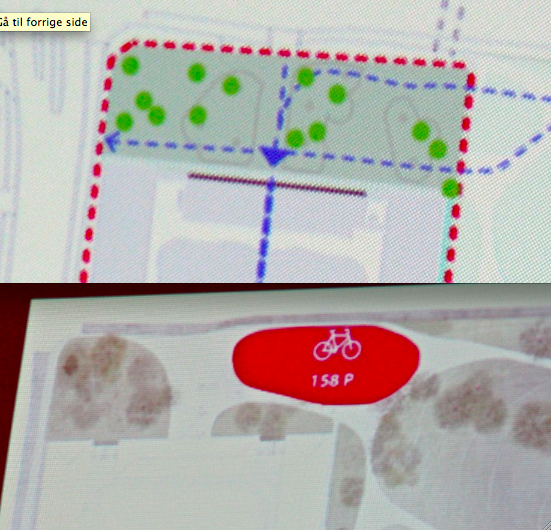
The architect had plenty to say about the part of the project to be build in the garden behind the museum, but nothing about the entrance area, with the bunker-hill landscape and beautiful forest of big old trees. On the rendering of the entrance area, everything has been cut down. I asked the architect about the plans, and was told that this part have not been settled yet. The only thing they know for sure, is the bike parking facility for a little over 150 bikes. But we are not to despair, as "any old tree cut down would be replaced".

We know exactly where we are headed. All you have to do is look across the street, to the opposite corner by the mutilated once-upon-a-garden at the National Museum of Denmark...

The questions posed by the citizens were an embarrassing display of parking-whining. The trees barely mentioned. No one fights for the trees at these meetings, and therefore no one at this level takes them into consideration. We must do better. All of us. This is serious business, we are losing our irreplaceable trees at an unheard pace.

The WW2 bunkers on the square are used for rehearsal studios, and there is currently a petition to save them, and incorporate them into the new plan. We are in support of that of course, because without the bunkers, the trees won't survive, as the roots are entangled with the foundation. All the bunkers and old trees may not be saved, but some must be preserved. We have to insist on that.

The hearing deadline is approaching (on Jan. 25th). We and the Local Council for Central Copenhagen, are both going to underline the importance of preserving the old trees. Everyone can leave a reply, so please do. Tell them that we prioritize other things than just parking. The worst-case scenario below is not yet decided, we still have time to fight, and hope for someone to listen to reason.


 Summer 2015 vs. the architect's vision. 

Pictures of the endangered oasis, from a blooming August day last year:


Snippets from two slides from the presentation. The old trees deemed worth preserving is counted at 14. And on top of half of them (?) suggested bike parking.


Link overview: